
Leveraged REIT Dividend Stripping

Executive view
Leveraged REIT dividend stripping is a tax-motivated yield capture strategy in which an investor borrows to buy REIT shares before a dividend record date, receives the dividend, then exits after the shares trade ex-dividend. REITs are structurally dividend-heavy because a REIT generally must have a dividends-paid deduction equal to at least 90% of REIT taxable income, excluding net capital gain, to satisfy a core distribution requirement (IRS Form 1120-REIT instructions). The appeal for an investor with large NOL carryforwards is that REIT dividend income may create taxable income that can absorb NOLs, while a post-dividend sale may generate a capital loss or lower gain that has separate tax value depending on the investor’s capital gain profile.
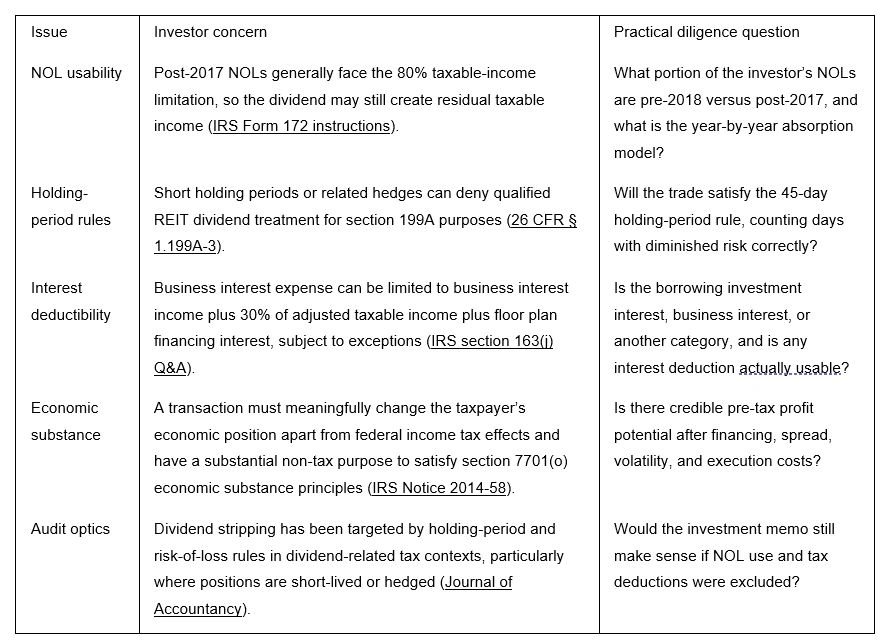
The strategy is only attractive if the after-tax value of using NOLs plus any capital-loss utility exceeds financing cost, bid-ask spread, dividend price drop, borrow constraints, tax leakage, and audit risk. Post-2017 NOL carryforwards generally can be carried forward indefinitely, but for taxable years after 2020 they generally cannot offset more than 80% of taxable income computed without the NOL deduction and certain other deductions (IRS Form 172 instructions). This means large NOLs may reduce, but not necessarily eliminate, tax on the dividend income if the investor’s usable NOLs are subject to the 80% limitation.

Mechanics and tax thesis
The basic trade is to acquire a high-dividend REIT position before the ex-dividend date, finance the purchase with margin or other borrowing, receive the dividend, then sell after the share price adjusts for the dividend. REIT dividends can include ordinary income, capital gain distributions, and return of capital, and the tax result depends on how the REIT reports the distribution on Form 1099-DIV or equivalent reporting (Nareit). Ordinary dividends are included in ordinary income, while qualified dividends receive lower capital-gain-style rates if they meet applicable requirements (IRS Topic 404).
For REITs, the most relevant shareholder benefit is often the section 199A qualified REIT dividend deduction, not qualified dividend treatment. Treasury regulations define a qualified REIT dividend as a REIT dividend that is neither a capital gain dividend nor qualified dividend income, but the dividend is excluded if the REIT share is held for 45 days or less during the 91-day period beginning 45 days before the ex-dividend date or if the shareholder has an obligation to make related payments on substantially similar or related property (26 CFR § 1.199A-3). A very short dividend capture trade may therefore lose section 199A treatment even if the dividend is otherwise REIT-sourced

.
Why NOLs matter
Large NOL carryforwards can make taxable dividend income more useful because they may convert otherwise taxable cash yield into a way to use trapped tax attributes. Section 172 allows an NOL deduction, and post-2017 NOLs carried to later years are generally limited to the lesser of the carried-forward post-2017 NOLs or 80% of the relevant taxable income base after accounting for older NOLs (26 U.S.C. § 172). The key modeling question is not “can the NOL offset the dividend,” but “how much of the dividend increases taxable income that the NOL can actually absorb in the same year.”
The capital side must be modeled separately. If the REIT share price falls by roughly the dividend amount after the ex-dividend date, the investor may have dividend income and an offsetting economic decline in share value. For individual taxpayers, net capital losses in excess of capital gains generally offset only up to $3,000 of other income per year, with unused losses carried forward, so a dividend-income and capital-loss mix can be materially worse than it looks unless the investor has current or expected capital gains to absorb the loss (IRS Topic 409).
Primary risks
Bottom line
The strategy can be worth screening only where the investor has highly reliable NOL capacity, current or expected capital gains, low-cost leverage, liquid REIT exposure, and a defensible non-tax investment rationale. It is not a “free” NOL monetization trade because dividend income, capital loss limits, section 199A holding-period rules, interest limitations, and economic substance doctrine can each break the expected result. The recommended next step is a tax-counsel-reviewed model comparing three cases: unlevered REIT ownership, leveraged dividend capture with minimum compliant holding period, and no trade, with sensitivities for dividend classification, financing cost, ex-dividend price movement, and NOL limitation.