
The Keys are the Target

Virginia Beach, VA - Mike Field, Qwyit LLC
On October 29, 2026, attackers moved roughly $6.3 billion out of Binance, most of it in about twenty minutes, in what Reuters described as the biggest heist in crypto history. Nothing in the published accounts suggests that any encryption algorithm was broken. Analysts at Elliptic concluded that the attacker made Binance's own systems sign the transactions instead of stealing its private keys, and Binance's incident report describes an internal signing service being used outside the normal withdrawal process. The attackers got to the people and systems that were allowed to ask for signatures, and the cryptography then did exactly what it was told.
That is the pattern in the breaches reviewed in this article. Health records, bank payment rails and digital-asset platforms are protected by mathematics that has no publicly known break. They fail because the keys, tokens and credentials that the mathematics trusts are stolen, left unencrypted, never revoked, or handed to a vendor.
Two forces are now pressing on that weak point. Artificial intelligence is making it faster and cheaper to find software flaws, impersonate people and harvest secrets. Quantum computing threatens the public-key algorithms that sit underneath certificates, key exchange and digital signatures, and the standard replacements are larger and harder to deploy.
This article reviews the recent record in three sectors, explains what AI and quantum computing really change, and then looks at how Qwyit, the cybersecurity subsidiary of HST Global, Inc., proposes to address these problems with its QCy cipher. The account of Qwyit draws on the company's white papers, patent filings and press release. A final section sets out what remains to be proven.
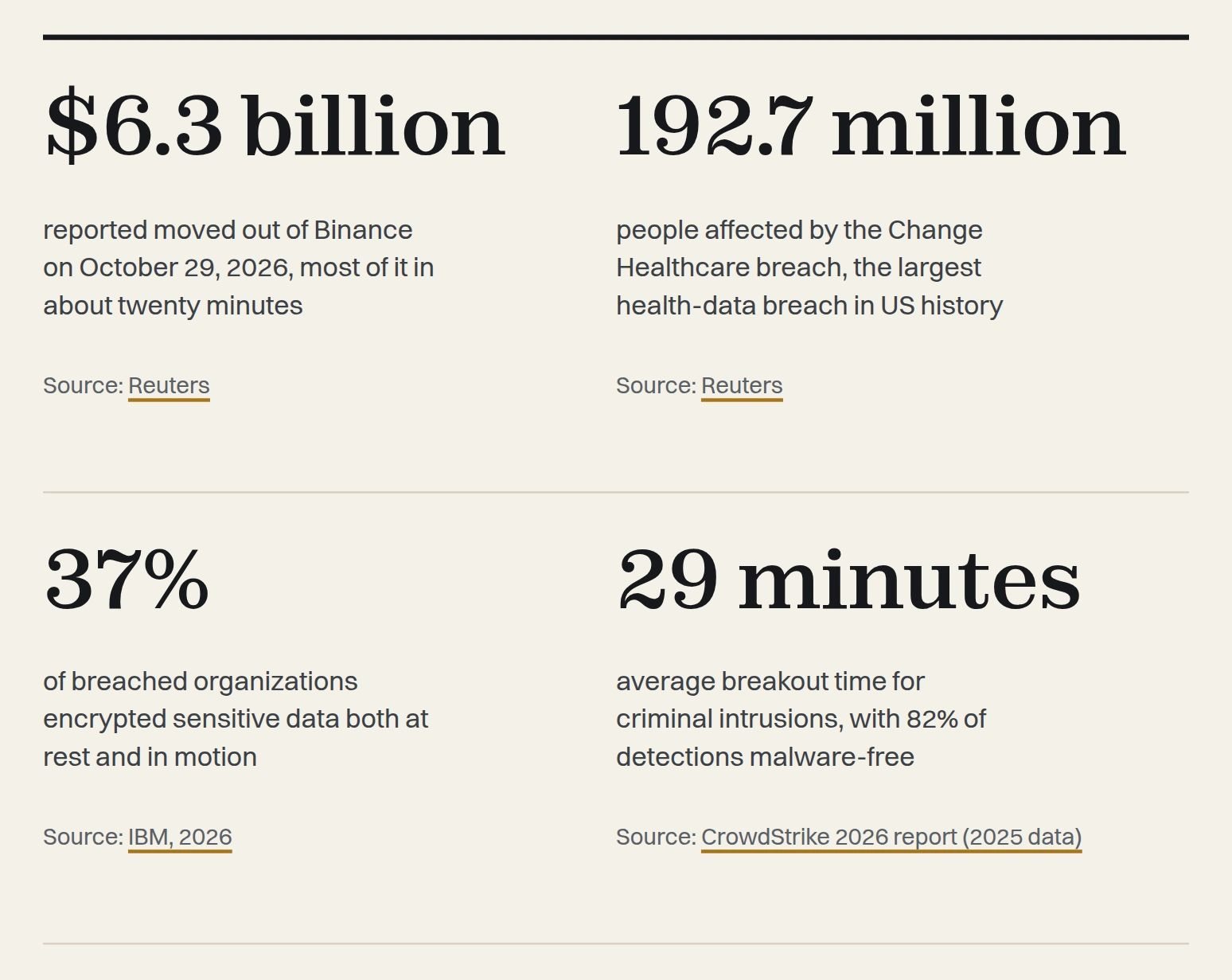
Sources: Reuters; Reuters; IBM, 2026; CrowdStrike 2026 report (2025 data)
Privacy: the data was reachable with a borrowed login

The largest health-data breach in US history started with a password. UnitedHealth's Change Healthcare unit was entered through a Citrix remote-access portal that had no multi-factor authentication, using compromised credentials, according to the chief executive's written testimony to Congress. The final count, confirmed in August 2025, was about 192.7 million people.
The cases that followed share the same shape.
- Coupang, South Korea. South Korea's Science Ministry said a former engineer had taken an authentication signing key, which was used to forge login tokens for the accounts of about 33.7 million customers, and that the company had failed to invalidate the key promptly after he left. A deputy minister called it "more of a management problem than an advanced attack".
- SK Telecom. South Korea's privacy regulator found that 26.1 million SIM authentication keys were stored unencrypted and issued a record fine.
- Salesloft Drift. Attackers stole OAuth tokens for a third-party sales tool and used them to read data in customers' Salesforce environments, then searched what they took for more secrets such as cloud access keys, according to Google's Threat Intelligence Group. FINRA put the number of affected organizations above 700 and noted that the tokens bypassed traditional multi-factor authentication.
- Salt Typhoon. The Chinese state-linked campaign against telecom carriers relied on known, unpatched flaws in network edge devices. The joint advisory from CISA and partner agencies states that exploitation of zero-day vulnerabilities had not been observed, and describes device secrets stored in weakly protected, reversible form.
- Conduent. The back-office processor for health plans and state agencies disclosed a breach that now covers more than 62.2 million people.
- TeleMessage. A modified version of Signal used by US officials archived messages on a server that exposed them in plaintext. Wired reported that the hack took about 15 to 20 minutes. The end-to-end encryption was real; it simply ended where the archive began.
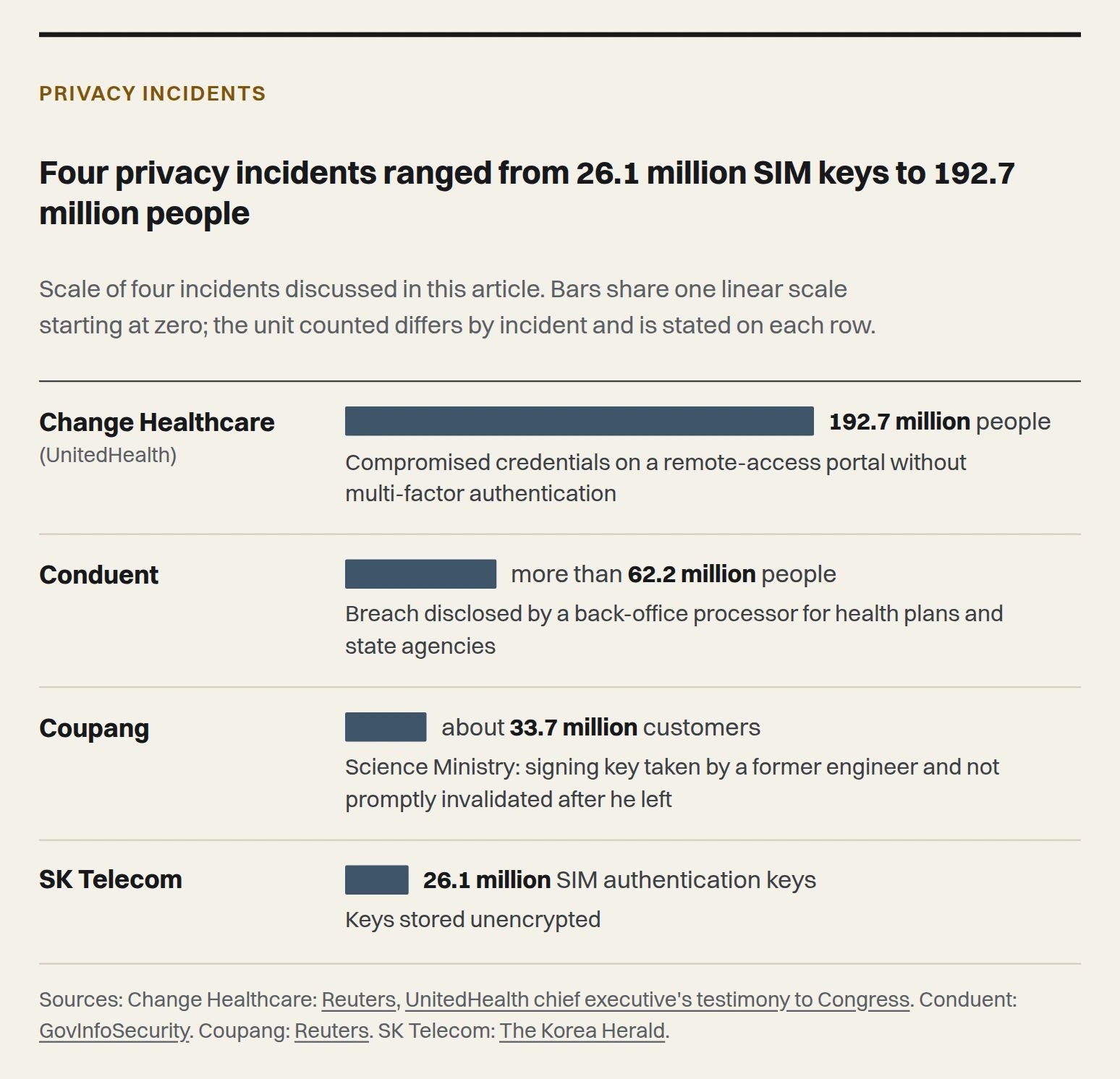
Sources: Change Healthcare: Reuters, UnitedHealth chief executive's testimony to Congress. Conduent: GovInfoSecurity. Coupang: Reuters. SK Telecom: The Korea Herald.
The industry statistics say the same thing in aggregate. IBM's 2026 Cost of a Data Breach Report put the average cost of a breach at a record $4.99 million globally and $11.50 million in the United States, and found that only 37% of breached organizations encrypted sensitive data both at rest and in motion. Verizon's 2026 Data Breach Investigations Report found a third party involved in 48% of breaches. The FBI's Internet Crime Complaint Center logged more than one million complaints and $20.9 billion in reported losses for 2025.
The lesson for encryption: in these cases the cipher was either absent or irrelevant. What mattered was a long-lived secret (a password, a signing key, a token) that worked for whoever held it, for as long as nobody noticed.
Finance: payment systems accepted fraudulent instructions as genuine
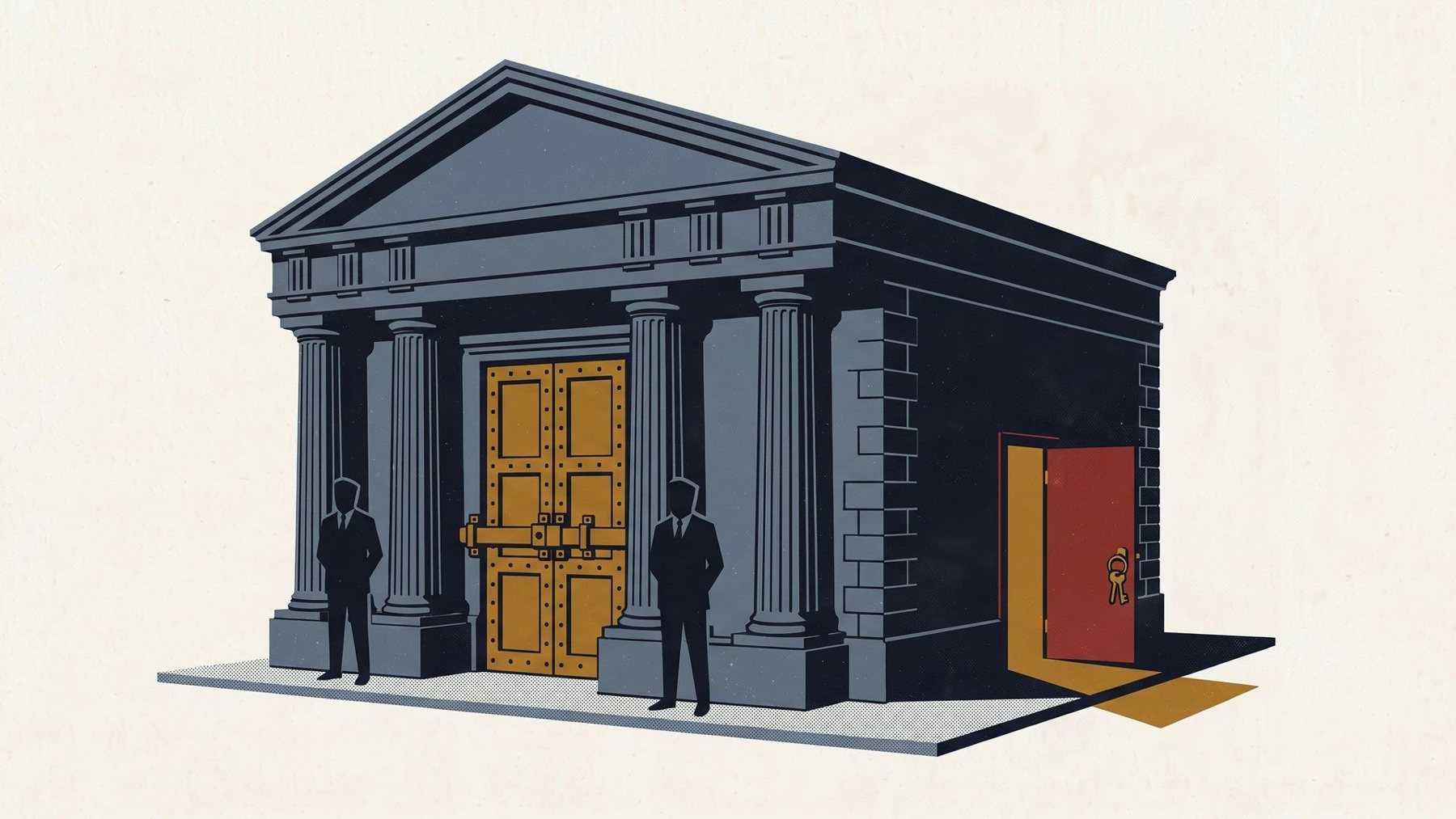
Bank payment networks are among the most heavily defended systems anywhere. The recent thefts did not go through those defenses. They went through parties the network already trusted.
- Crédit Mutuel Arkéa, France. In November 2026 the bank said around €100 million was missing after attackers used an account belonging to the bank through a third-party service provider's platform, as Reuters reported. The chairman told Les Echos it was as if the attackers had obtained a bunch of keys.
- Brazil's Pix system. In mid-2025, attackers struck C&M Software, a vendor that connects institutions to the central bank, as Reuters reported. More than 540 million reais was taken from at least one institution, and police said an IT employee had sold his login for about $2,700, according to The Record. Two months later, about $130 million moved through another vendor, Sinqia, using legitimate IT vendor credentials, according to BankInfoSecurity.
- India. The Reserve Bank of India tightened cyber checks on lenders in October 2026 and asked banks to probe weaknesses in their APIs, after the national cyber agency CERT-In warned that hackers were stealing banks' API credentials to move money, Reuters reported.
- Marquis Software. A ransomware attack on this vendor disrupted 74 US banks. Marquis has sued its firewall supplier, SonicWall, alleging that the theft of cloud-stored firewall configuration backups opened the door, according to BleepingComputer. That is Marquis's allegation in litigation, not an established finding.
- The regulator itself. The US Office of the Comptroller of the Currency reported a major incident to Congress in April 2025 after unauthorized access to its email system through a compromised administrative account.
The lesson for encryption: a payment message is authenticated by a credential or a signing key. If that credential is valid, the system has no way to tell a thief from the bank. Vendors multiply the number of places where such credentials live.
Crypto: the signatures were valid
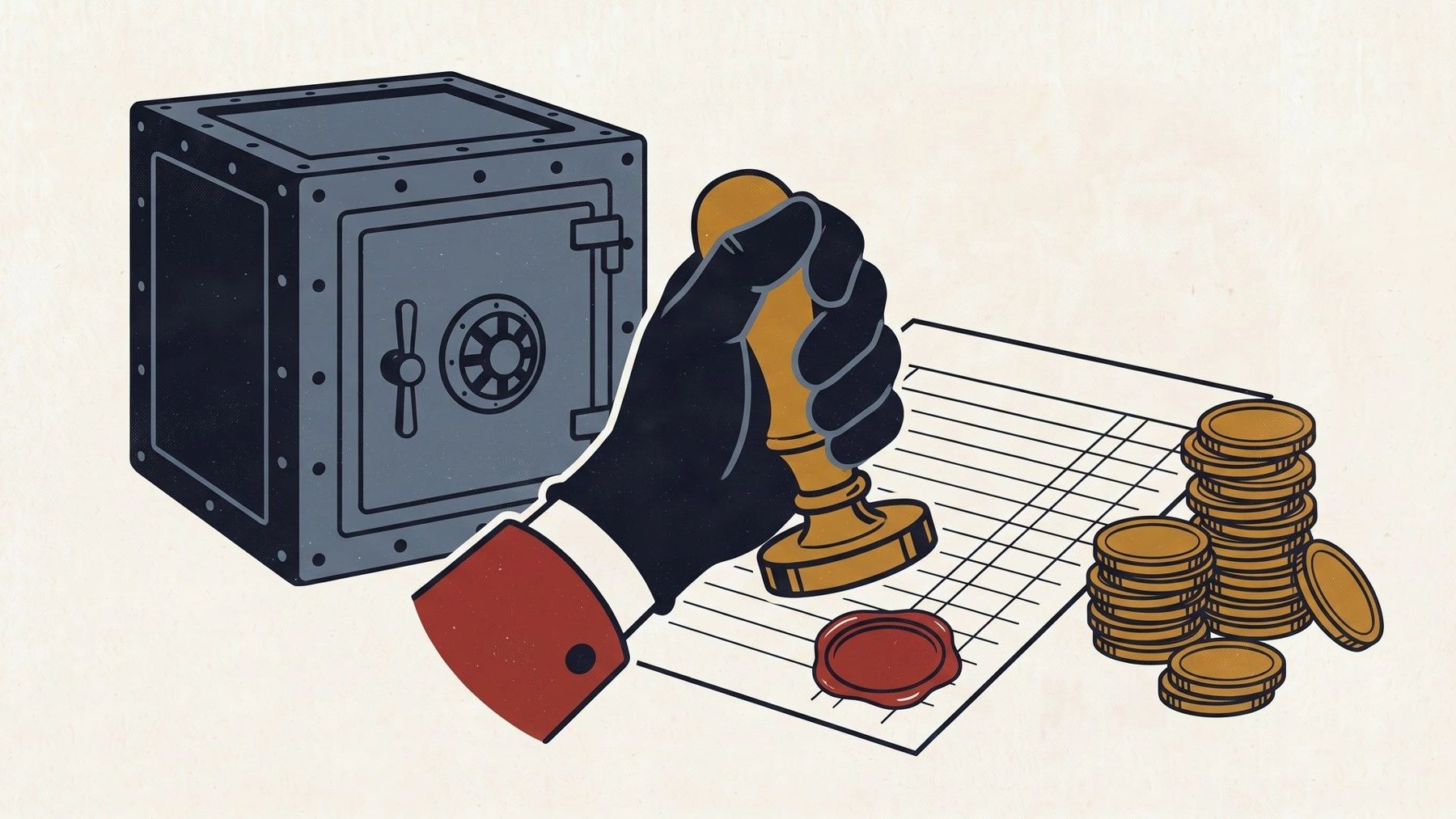
Digital assets are the purest test of key management, because the key is the asset. The numbers for 2026 are without precedent. Blockchain-analysis firm TRM Labs counted $8.7 billion stolen in 2026 through October 29, of which about $7.4 billion, or 85%, went to North Korea.
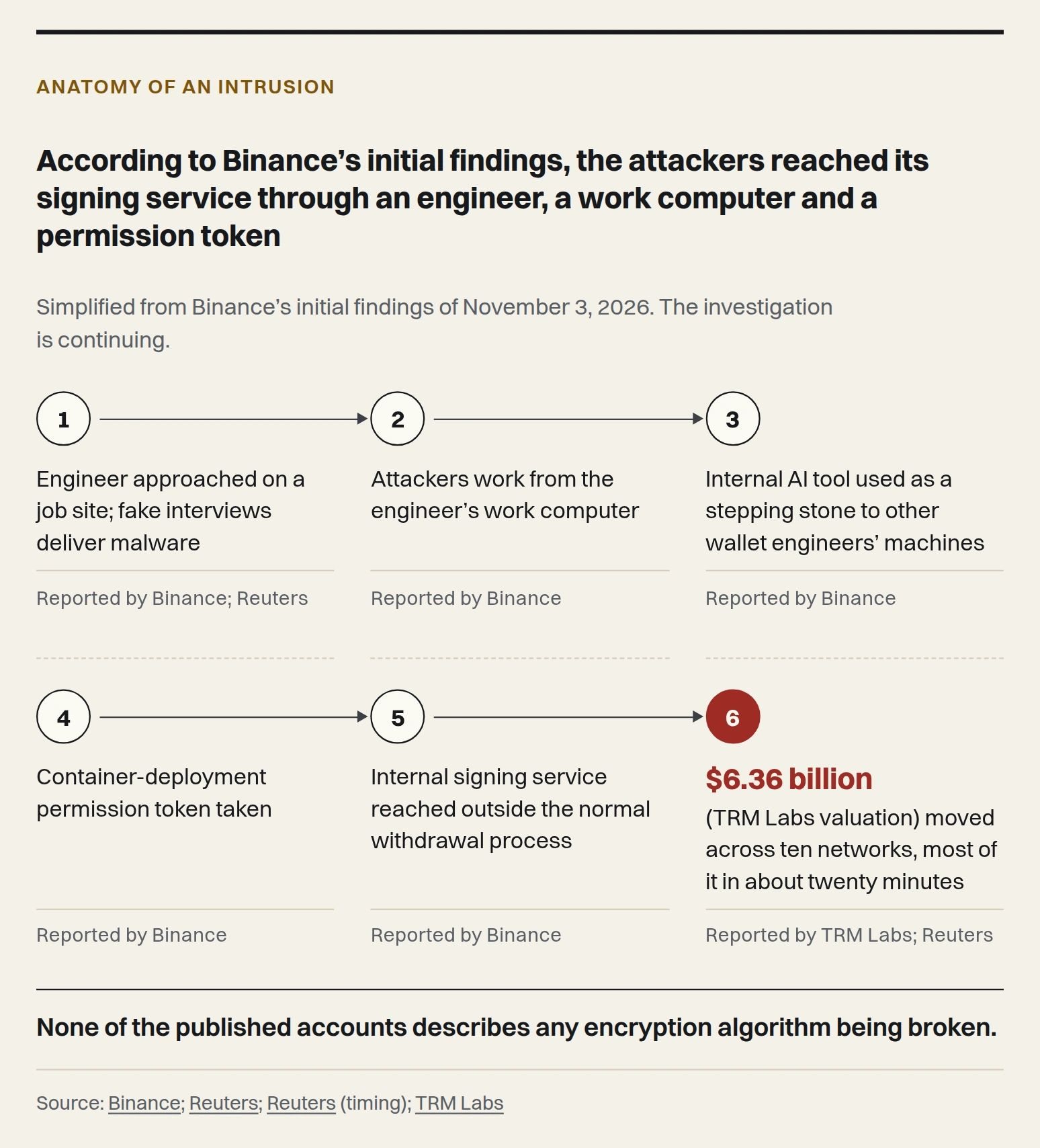
Binance. The company's account of the October theft reads like a study in indirect access. An engineer was approached on a job site and put through fake interviews that delivered malware. From that computer, the attackers used an internal AI tool as a stepping stone into other wallet engineers' machines, took a container-deployment permission token, and used it to reach the exchange's internal signing service outside the normal withdrawal process, according to Binance. TRM Labs valued the loss at $6.36 billion across ten networks. The US Justice Department attributed the theft to North Korea and announced court orders covering more than $1.2 billion of the proceeds.
Source: Binance; Reuters; Reuters (timing); TRM Labs
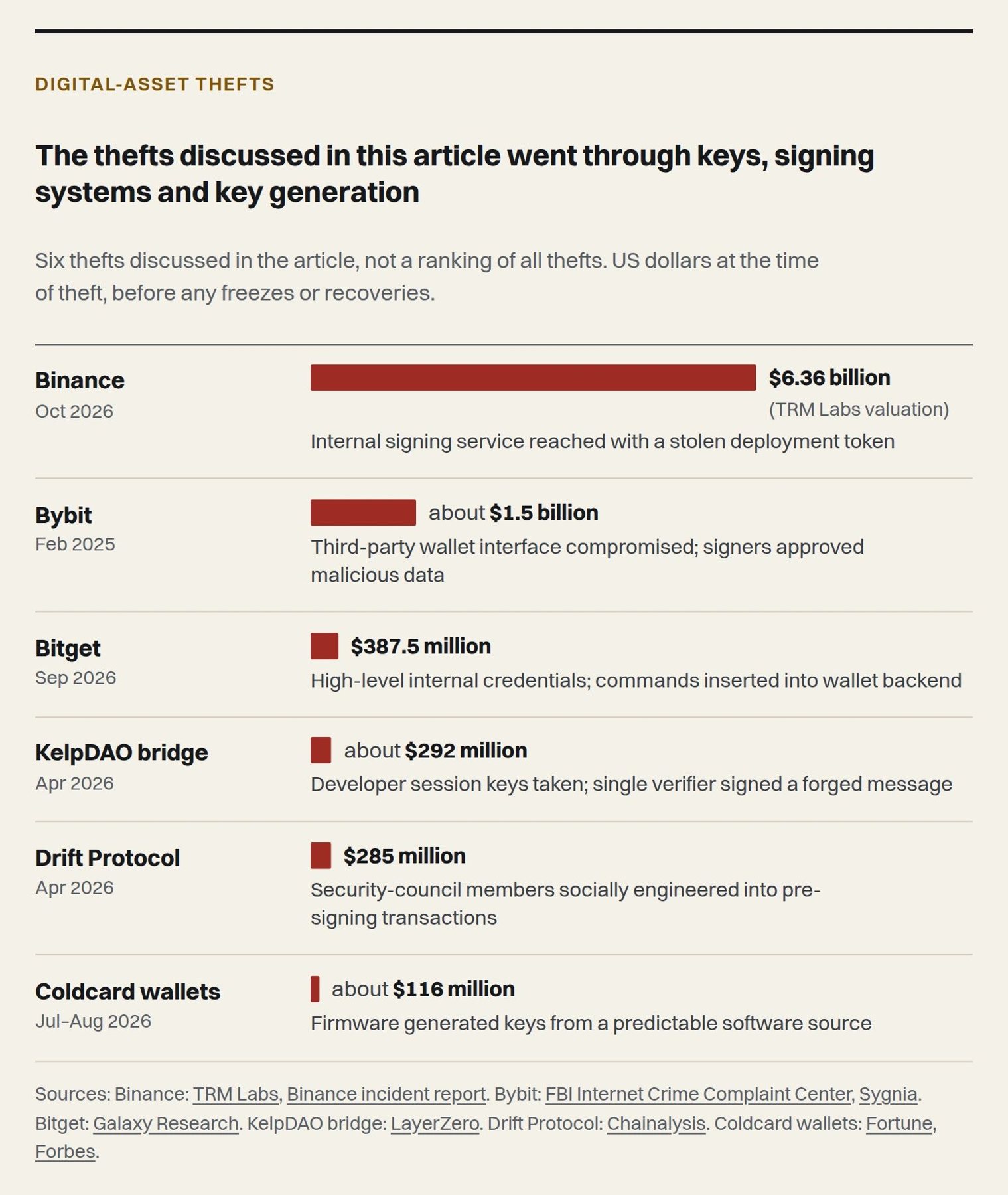
Bybit. In February 2025, about $1.5 billion left Bybit's cold wallet. The FBI attributed the theft to North Korea's TraderTraitor group. Bybit said its own infrastructure was not compromised. The attackers had compromised a developer at the third-party wallet provider, and the wallet interface showed signers legitimate transaction details while malicious data was being signed, according to Sygnia's forensic case study.
The same method, repeated. Bitget lost $387.5 million in September 2026 when attackers obtained high-level internal credentials and inserted withdrawal commands into its wallet backend, with private keys and cold storage intact, according to Galaxy Research. In April 2026, the KelpDAO bridge lost roughly $292 million after a LayerZero developer's session keys were taken and the bridge's single verifier was tricked into signing a forged message, according to LayerZero's incident report. Drift Protocol lost $285 million the same month after members of its security council were socially engineered into pre-signing transactions that handed administrative control to the attackers, according to Chainalysis.
When key generation or hardware fails. Not every case was social. About $116 million in bitcoin was swept from Coldcard hardware wallets in July and August 2026, Fortune reported. A firmware build setting had told the devices to skip their hardware randomness chip and generate keys from a predictable software substitute, according to Forbes. In October, Ledger confirmed that a hardware spy implant had been found in a device sold through a reseller. And Coinbase disclosed in a filing with the SEC that paid-off overseas support staff had copied customer data, at an expected cost of $180 million to $400 million; the breach affected 69,461 users.
Sources: Binance: TRM Labs, Binance incident report. Bybit: FBI Internet Crime Complaint Center, Sygnia. Bitget: Galaxy Research. KelpDAO bridge: LayerZero. Drift Protocol: Chainalysis. Coldcard wallets: Fortune, Forbes.
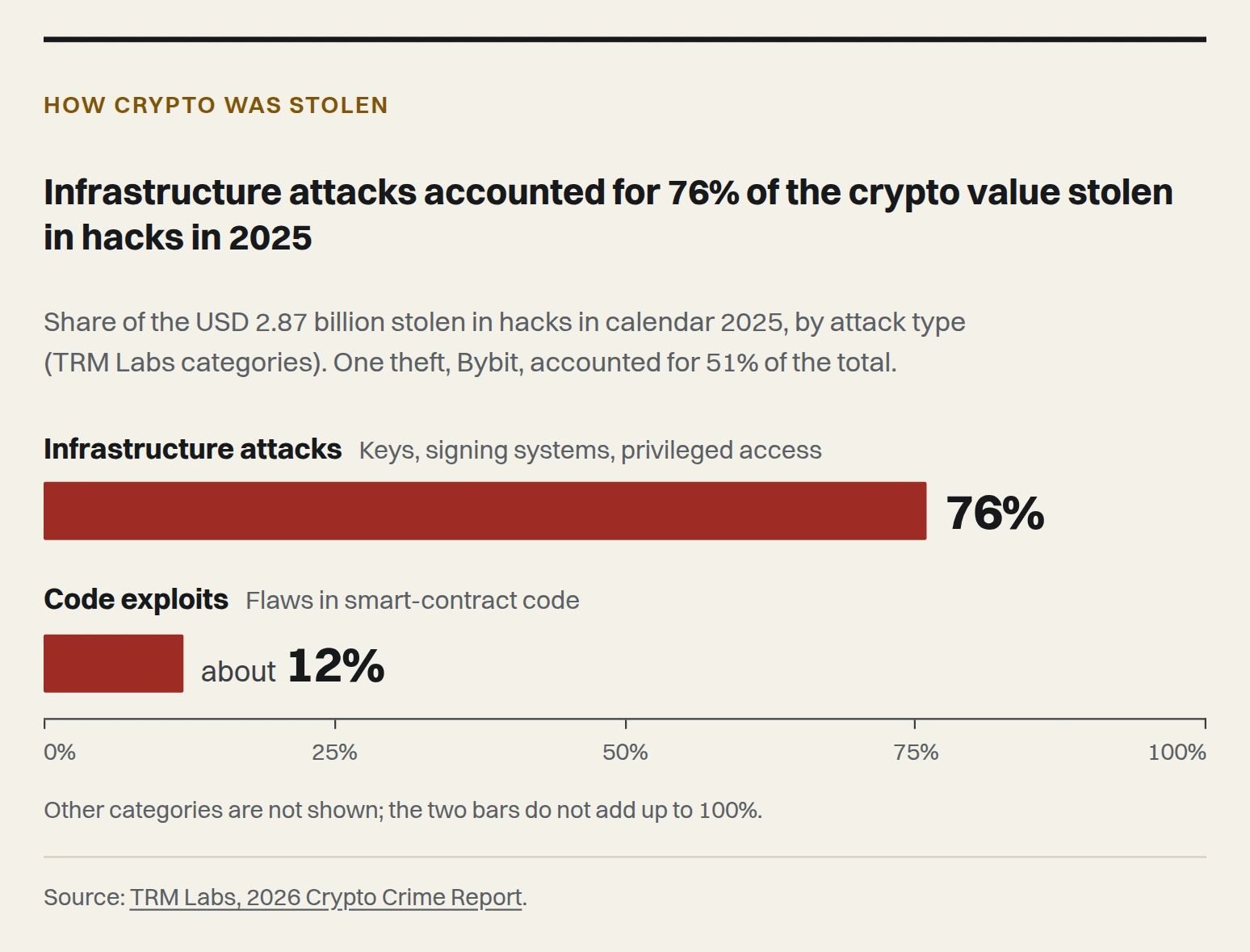
TRM Labs' breakdown for 2025 summarizes the sector: attacks on infrastructure, meaning keys, signing systems and privileged access, accounted for 76% of stolen value, while flaws in smart-contract code accounted for about 12%.
Source: TRM Labs, 2026 Crypto Crime Report.
The lesson for encryption: none of these accounts describes an elliptic-curve signature being broken. In the largest cases, intact keys produced valid signatures on transactions the owners did not intend.
How AI is changing encryption

It is worth being precise here, because the topic attracts exaggeration.
What AI has not done
No AI system has broken AES, RSA-2048, elliptic-curve cryptography or any of the post-quantum algorithms NIST has finalized. The mathematics of deployed encryption stands.
What AI has done
It has found a real mathematical weakness in a candidate algorithm. In July 2026, Anthropic reported that its Claude Mythos Preview model had discovered a key-recovery attack on HAWK, a signature scheme then in the third round of NIST's additional post-quantum signature process. The attack cut the work needed to recover a HAWK-256 key from about (2^{64}) operations to about (2^{38}). NIST's round-three page now records HAWK's withdrawal. The same research sped up the best known attack on a reduced, seven-round version of AES-128 by a factor of 200 to 800; that attack remains impractical and full AES is unaffected. HAWK was a candidate, not a standard. Still, it appears to be the first publicly documented case of an AI model's original cryptanalysis leading to a candidate's withdrawal from a NIST standards process.
It is finding implementation flaws at industrial scale. All twelve vulnerabilities fixed in OpenSSL's January 27, 2026 security advisory were found by one company's autonomous analyzer, which went on to reach twenty OpenSSL findings in six months. Anthropic says partners in its Project Glasswing program had identified more than 10,000 high- or critical-severity vulnerabilities by June 2026. The defenders got there first in these cases. The capability itself is neutral, and the code that implements encryption is exactly the kind of code it examines.
It is running intrusions. In November 2025, Anthropic described the first reported AI-orchestrated espionage campaign, in which a state-linked group had an AI agent carry out an estimated 80 to 90% of the work against roughly thirty targets, including harvesting credentials. On November 16, 2026, Google's threat intelligence team reported that agentic threat activity had crossed a significant threshold. CrowdStrike's 2026 report found that 82% of detections were malware-free and that the average breakout time for criminal intrusions had fallen to 29 minutes: attackers log in with real credentials and move quickly.
It is defeating the human check. Encryption protects the channel; it does not tell you whether the person on the video call is real. Engineering firm Arup lost about $25.6 million after an employee joined a call populated by deepfaked colleagues. Federal prosecutors in New York unsealed an indictment on November 5, 2026 charging three people with using AI to imitate the voices and images of executives and lawyers, in a scheme that took more than $129 million from companies. IBM found that one in four malicious breaches was AI-enabled, at an average cost of about $6 million.
It is leaking and extracting secrets. GitGuardian counted about 29 million secrets pushed to public GitHub repositories in 2025, including 1,275,105 tied to AI services. Machine learning also sharpens side-channel attacks, which recover keys from a chip's power use or timing. A study published in PLOS ONE in November 2026 recovered the full secret message from a single power trace of the new post-quantum standard ML-KEM in 99.4% of attempts on the profiled chip. The algorithm was sound; the device running it gave the secret away.
It may shorten the road to quantum. Google reported in July 2026 that a reinforcement-learning agent tuning its Willow processor during operation lowered logical error rates by about 20%. Error correction is the main obstacle between today's machines and one that threatens encryption.
What this means
AI has not made encryption weaker. It has made everything around encryption weaker, faster. Three consequences follow.
- Static secrets have a shorter safe life. If an attacker can go from first access to lateral movement in half an hour, a key or token that stays valid for months is a standing liability.
- Implementation size is now a security property. Every line of cryptographic code is a line an automated analyzer will read. Smaller, simpler implementations are easier to verify before an adversary does.
- New algorithms need more scrutiny, not less. HAWK was designed by experts and had survived two rounds of public review. Any new cipher, including Qwyit's, should expect the same machine-assisted examination.
Why the quantum stage will cause real problems

What a quantum computer breaks
Shor's algorithm, run on a large enough fault-tolerant quantum computer, solves the mathematical problems behind RSA, Diffie-Hellman and elliptic-curve cryptography. Those are the public-key algorithms used to exchange keys, issue certificates and sign transactions. NIST's final transition guidance lists all of them as quantum-vulnerable.
Symmetric ciphers are in a different position. Grover's algorithm offers only a quadratic speed-up against them, and NIST says it is quite likely that Grover's algorithm will give little or no practical advantage against AES. The quantum problem is a public-key problem. That distinction matters for everything that follows.
How close it is
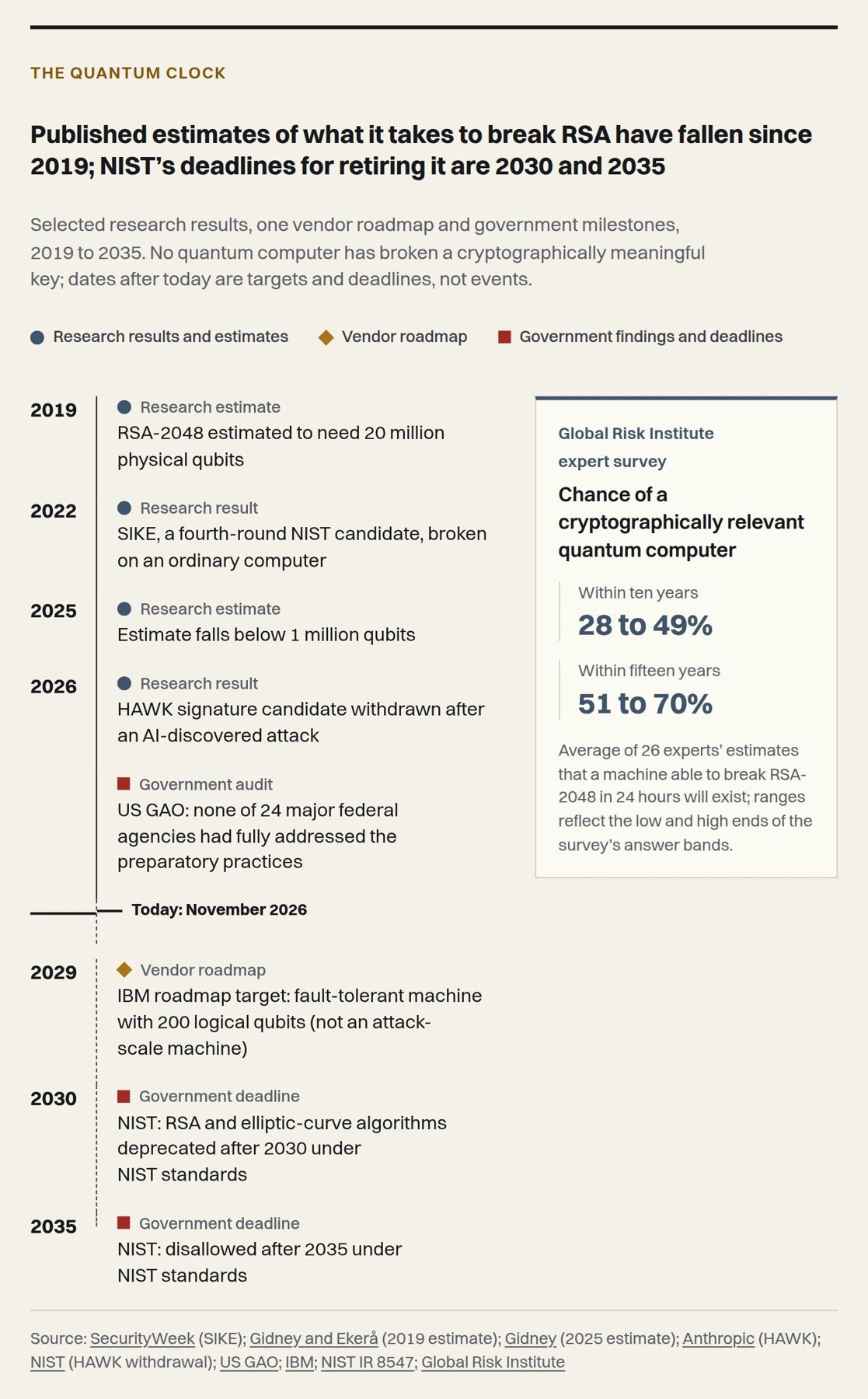
No quantum computer has broken a cryptographically meaningful key. The best demonstrated systems have tens of error-corrected logical qubits; an attack needs on the order of a thousand or more. The concern is the direction of the estimates.
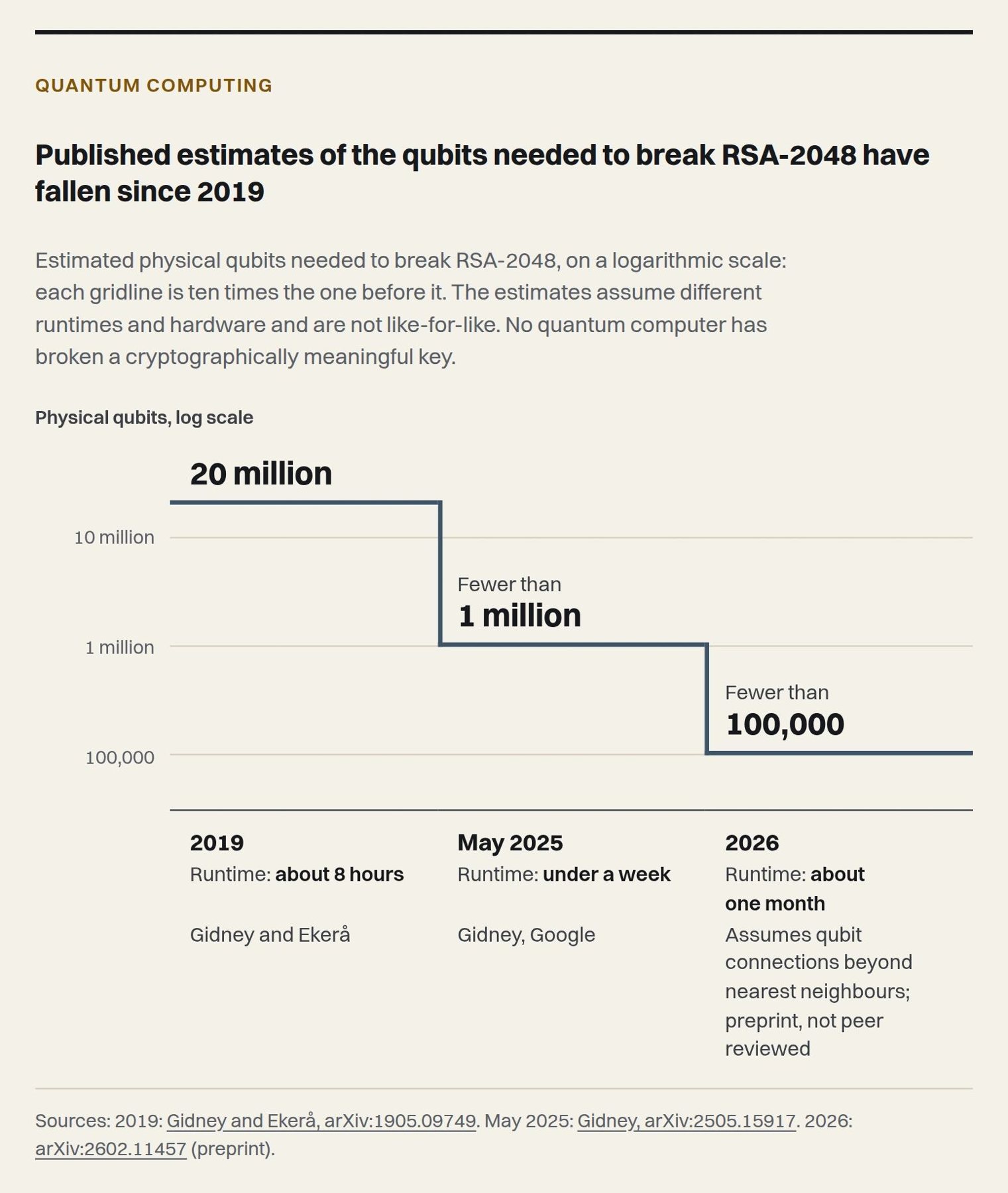
- In 2019, breaking RSA-2048 was estimated to need 20 million physical qubits. In May 2025, Google's Craig Gidney showed how to do it with fewer than one million in under a week. A 2026 preprint argues for fewer than 100,000 under more demanding hardware assumptions; it has not been peer reviewed.
- A 2026 paper from researchers at Google, Stanford and the Ethereum Foundation estimates that the elliptic curve securing Bitcoin and Ethereum could be broken with fewer than 500,000 physical qubits in minutes, fast enough in principle to attack a transaction while it waits for confirmation.
- IBM's roadmap targets a fault-tolerant machine with 200 logical qubits in 2029.
- The Global Risk Institute's latest expert survey puts the chance of a cryptographically relevant quantum computer at 28 to 49% within ten years and 51 to 70% within fifteen.
Sources: 2019: Gidney and Ekerå, arXiv:1905.09749. May 2025: Gidney, arXiv:2505.15917. 2026: arXiv:2602.11457 (preprint).
Why the problem starts before the machine exists
Harvest now, decrypt later. Data intercepted today can be stored until it can be read. The NSA describes adversaries harvesting encrypted data now for later decryption. Europol, in an October 2026 report, said there is currently no clear evidence of systematic exploitation at scale, while warning that medical records, government communications and other long-lived data are the most exposed. Either way, the risk attaches to anything that must stay secret for more than a decade.
Blockchains publish their targets. A public blockchain records public keys and signatures permanently. The Google-led paper estimates that about 6.9 million bitcoin sit in addresses whose public keys are already exposed. Those cannot be re-encrypted after the fact; they have to be moved by their owners.
The deadlines are short. NIST's guidance deprecates RSA and elliptic-curve algorithms after 2030 and disallows them after 2035. A June 2026 executive order sets dated federal requirements for the migration. In October 2026 the Government Accountability Office found that none of the 24 major federal agencies had fully addressed the preparatory practices.
Source: SecurityWeek (SIKE); Gidney and Ekerå (2019 estimate); Gidney (2025 estimate); Anthropic (HAWK); NIST (HAWK withdrawal); US GAO; IBM; NIST IR 8547; Global Risk Institute
The replacements are heavy. The standardized post-quantum signatures are far larger than what they replace. Cloudflare calculates that switching the five signatures and two public keys in a first-visit TLS handshake to ML-DSA-44, the smallest version, adds about 15 kilobytes. The Bank for International Settlements' Project Leap, run with three European central banks and Swift, replaced traditional signatures with post-quantum ones on liquidity transfers, using the test environment of an operational payment system, and found significant performance differences between the two, pointing to the need for more testing before the financial system makes the switch. Older industrial controllers and embedded devices often lack the memory to run the new algorithms at all.
New algorithms carry new risk. SIKE, a candidate that had reached the fourth round of NIST's post-quantum process, was broken in 2022 using an ordinary computer. HAWK fell in 2026. Early implementations of the Kyber standard leaked secrets through timing, a flaw catalogued as KyberSlash. Replacing every public-key system in the world with younger mathematics, under deadline, is itself a source of risk.
The stakes are systemic. A Hudson Institute study estimated that a hypothetical quantum attack on the Fedwire payment system could cause $2.0 to $3.3 trillion in indirect losses.
Put the three trends together. Attackers already win by taking keys. AI is making that faster. A large enough quantum computer would break the public-key layer that distributes and vouches for those keys, and the standardized replacements are larger and newer. The question is whether there is another way to build the key layer.
How Qwyit proposes to solve these problems

Qwyit LLC is a wholly owned subsidiary of HST Global, Inc. (OTCID: HSTC), based in Virginia Beach, Virginia. Its core technology is the QCy cipher. What follows is drawn from the company's May 2, 2026 press release, its white papers on blockchain, Ethereum, financial settlement, healthcare records and critical infrastructure, and its provisional patent filings.
The core idea: remove the public-key layer
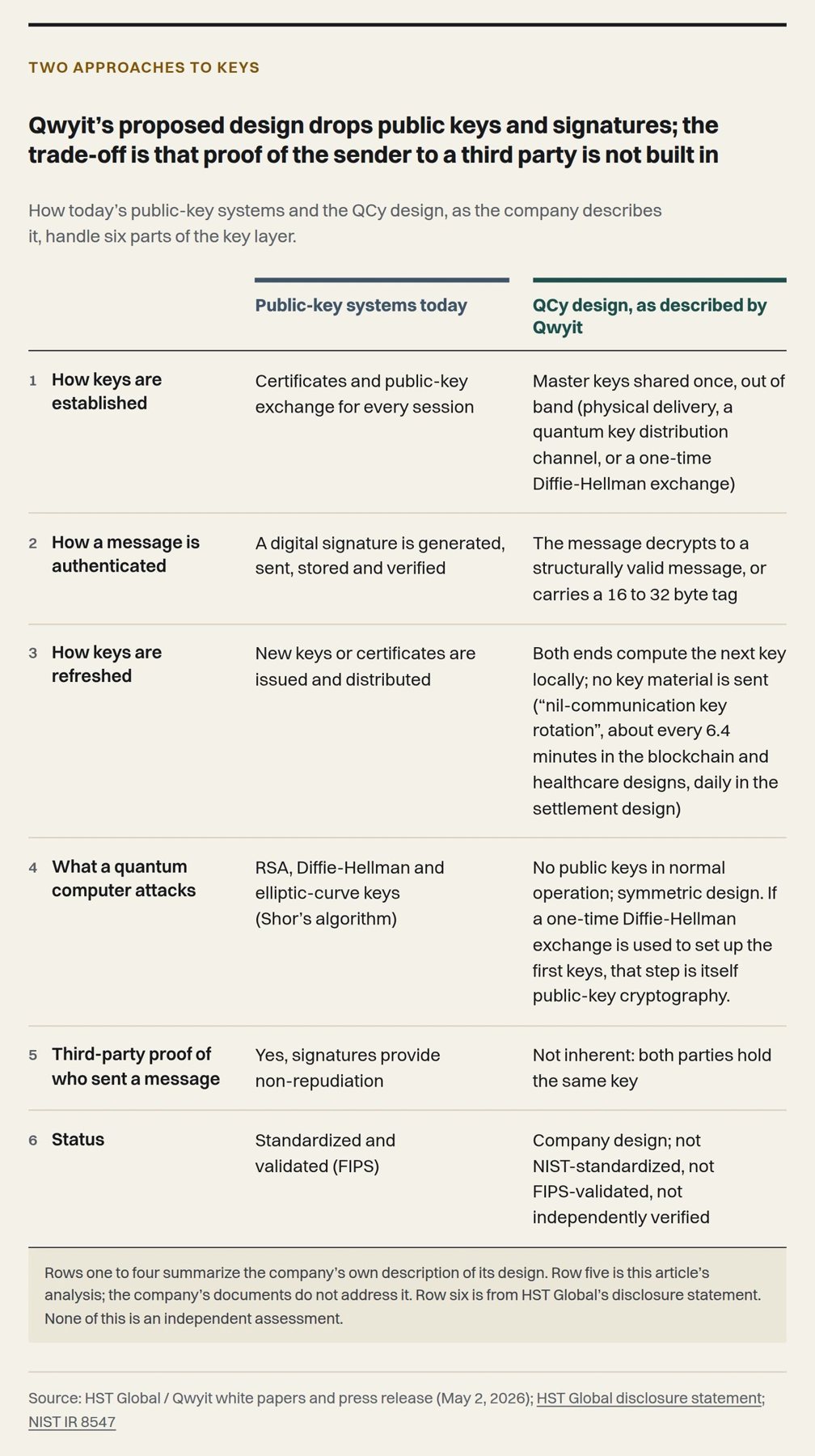
QCy is a symmetric stream cipher. Two parties share master keys, and everything else is derived from them. In normal operation the design uses no public keys, no certificates and no digital signatures. According to the company's materials:
- Authentication comes from decryption. A message is accepted as genuine if it decrypts under the shared key to a structurally valid message, or carries a short authentication tag of 16 to 32 bytes. There is no separate signature to generate, transmit, store or verify. Where the content has no structure to check, the critical infrastructure paper requires a conventional keyed hash (HMAC-SHA-256) as the tag.
- Keys rotate without any message being sent. The company calls this nil-communication key rotation. Both ends compute the next key locally from state they already share. In the blockchain and healthcare designs this happens about every 6.4 minutes; in the settlement design, daily.
- The implementation is small. The company puts the cipher at under 4 kilobytes of code and fewer than 500 lines of C, able to run on 8-bit microcontrollers as well as in FPGA or ASIC hardware.
- Ciphertext is the same length as plaintext. The encrypted body does not grow. The critical infrastructure paper notes that a short per-message value and an optional authentication tag are sent alongside it.
Initial keys have to be established once, out of band. The blockchain white paper lists physical delivery, a quantum key distribution channel, or a one-time Diffie-Hellman exchange used only to bootstrap.
Source: HST Global / Qwyit white papers and press release (May 2, 2026); HST Global disclosure statement; NIST IR 8547
Problem one: stolen keys and credentials that stay useful
Several breaches described above involved secrets that stayed valid long after they were taken. Qwyit's design aims to shorten the life of working keys by rotating them without sending key material. Initial keys still have to be delivered and stored securely. In the healthcare design, the company says a revoked permission takes effect at the next rotation, roughly 6.4 minutes later, and that a copied session key expires at that point. Whether an attacker who copies a device's full state could follow later rotations is one of the open questions listed below.
The company has also filed a provisional application for what it calls AIQwyit, described as using AI to adjust encryption security dynamically, for example tightening key rotation when anomalies appear. The company's documents give limited technical detail on this component.
Problem two: one breach exposes everything
Large health-data breaches have exposed many records through a single point of entry. Qwyit's healthcare white paper proposes a different structure. It is a design that has not yet been built or tested in a health system:
- The patient's phone generates the master keys for the patient's record and keeps them in its secure hardware. At enrollment a copy is delivered to the hospital's hardware security module in fragments over separate channels, so the keys exist in two places.
- The record is split into sections, each encrypted under its own key.
- Each role receives keys only for the sections it needs. In the paper's example, a pharmacist's workstation can decrypt medications and cannot decrypt diagnoses or lab results.
- Encrypted records are anchored on a signature-free blockchain rather than held in one central database.
The paper's stated result is that a compromised pharmacy desktop yields only medication data, and only for patients who have given that pharmacy consent. The company proposes the same principle, limiting what any one stolen key can open, for its other designs. The company proposes a first pilot of 1,000 to 5,000 patients in a single health system; that pilot is a plan, not a completed project.
Problem three: payment authentication that depends on signatures and vendors
Qwyit's financial settlement white paper and the accompanying provisional patent filing address interbank systems such as Fedwire, CHIPS and Swift. In the proposed design, each bank shares a key with the central settlement authority, keys are held in hardware security modules, and they rotate daily with no key material crossing the network. Each payment message carries a QCy authentication tag.
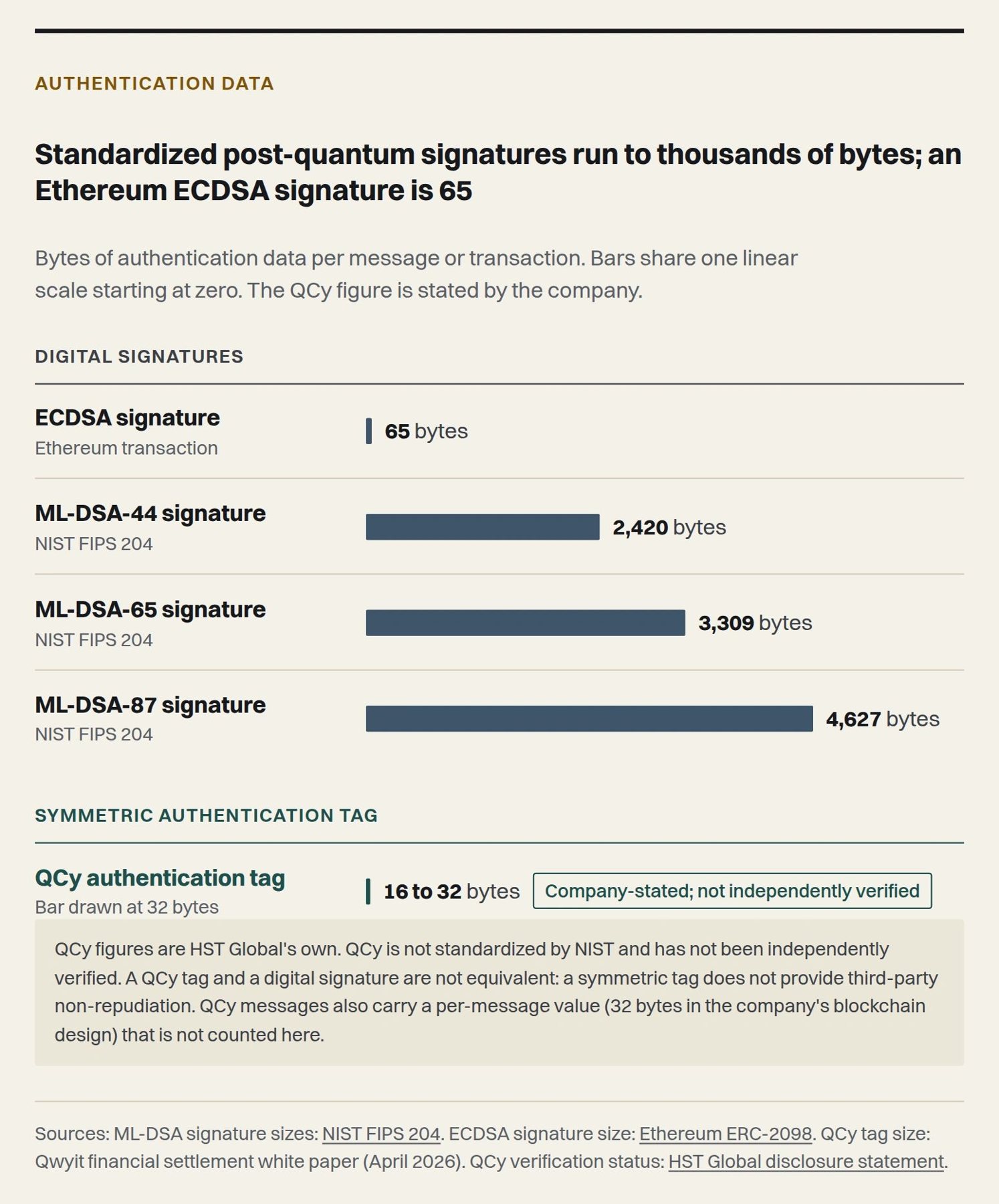
The company's main argument is about the cost of the quantum transition. An ML-DSA-65 signature, the NIST post-quantum standard at that level, is 3,309 bytes. The company states that a QCy authentication tag is 16 to 32 bytes, roughly one hundredth of that at the upper end. A tag is not a signature, and QCy messages also carry a per-message value that the white papers put at 32 bytes. For systems that process hundreds of millions of messages a year and must retain them, the company argues that this avoids the bandwidth, storage and processing burden that studies such as Project Leap have been measuring.
Sources: ML-DSA signature sizes: NIST FIPS 204. ECDSA signature size: Ethereum ERC-2098. QCy tag size: Qwyit financial settlement white paper (April 2026). QCy verification status: HST Global disclosure statement.
The white paper proposes a phased rollout that begins with a ten-bank pilot running conventional RSA signatures and QCy side by side. No pilot or bank partner is reported.
Problem four: blockchains that are both exposed and expensive to fix
On May 2, 2026, HST Global announced two provisional patent applications. One covers a blockchain built from the ground up with no digital signatures at any layer. The other covers a way to retrofit QCy authentication onto existing networks, including Ethereum, in phases and without a network-wide hard fork, using the ERC-4337 account abstraction framework.
The company's case rests on three points.
- Size. The release states that per-transaction cryptographic overhead falls from 65 bytes for today's ECDSA signature, or roughly 2,400 to 4,600 bytes for lattice-based post-quantum signatures, to zero. The white papers add that each transaction still carries a 32-byte per-message value.
- Speed. It gives a figure of about 0.26 milliseconds to validate a 512-validator committee. The release describes this as calculated, not measured.
- Exposure. In the native design, according to the blockchain white paper, accounts are derived from hashes of key material and no public key is ever placed on the chain, so there is nothing for a future quantum computer to harvest. Transactions are encrypted in full, with an optional transparency mode.
Chief executive Michael P. Fortkort framed the argument this way in the release: "The blockchain industry has been asked to accept a difficult tradeoff: adopt post-quantum cryptography and pay for it in performance, throughput, and gas costs, or defer the transition and accept a widening window of quantum risk. The QCy architecture demonstrates that this tradeoff is not necessary."
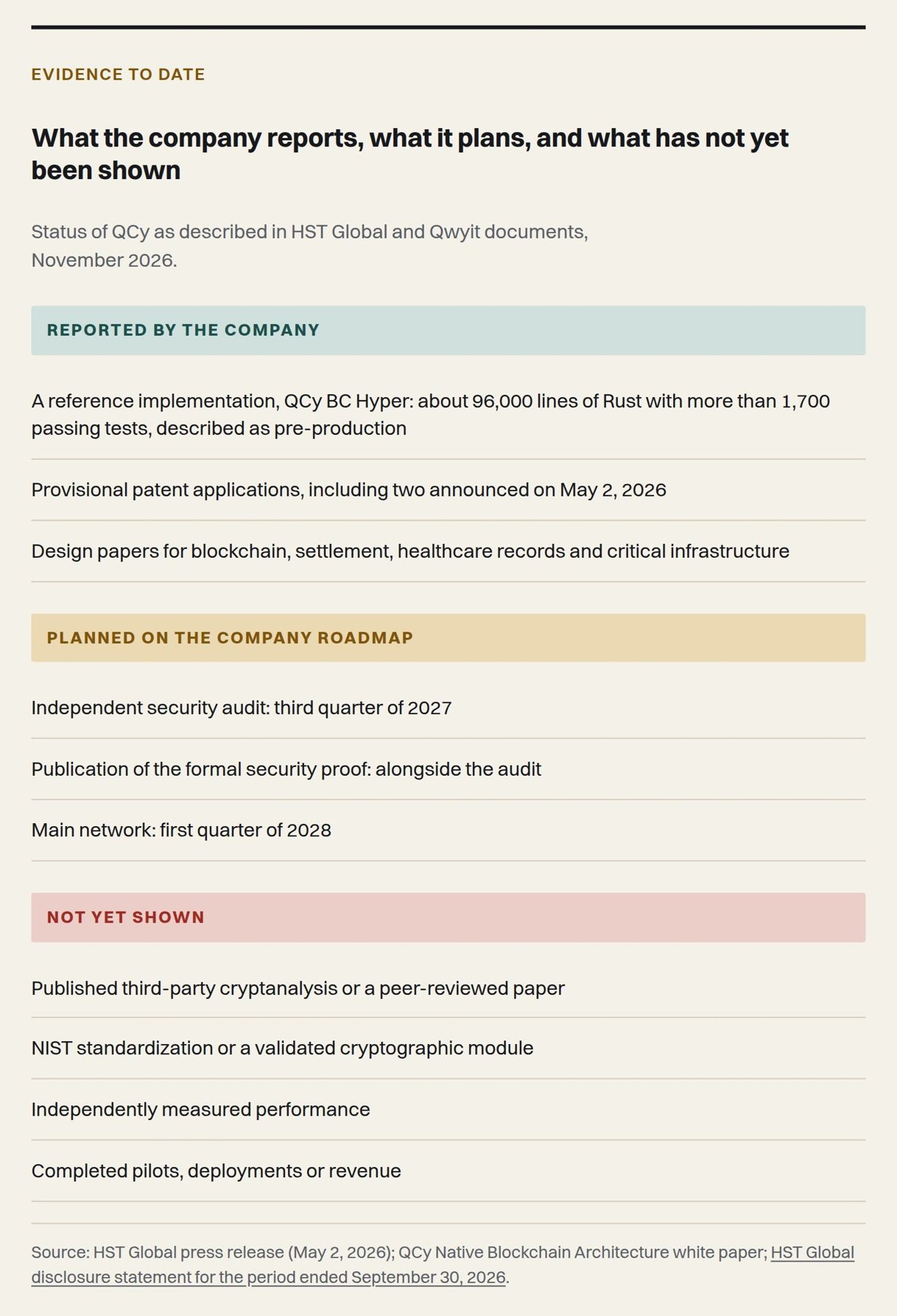
The company reports a working reference implementation, QCy BC Hyper, of about 96,000 lines of Rust with more than 1,700 passing tests. The release describes it as "a pre-production reference milestone intended for controlled testnet and pilot deployments, not as a release candidate for unattended production operation." The blockchain white paper's roadmap places an independent security audit in the third quarter of 2027 and a main network in the first quarter of 2028.
Problem five: the quantum threat itself
Qwyit makes two arguments, and they should be kept apart.
The first is structural. QCy is symmetric, and Shor's algorithm attacks public-key mathematics, so a system with no public keys gives it nothing to work on. NIST expects its approved symmetric algorithms, such as AES, to remain usable for the same reason.
The second is much stronger. The company states that QCy is formally proved to meet the definition of an "Ideal System" in Claude Shannon's 1949 theory of secrecy, meaning that an attacker who sees ciphertext, and even matching plaintext, is left with irreducible uncertainty about the keys. On that basis the company describes the cipher's security as unconditional and "quantum-invariant", independent of any advance in classical or quantum computing. The proof has not been published. The blockchain white paper lists formal proof publication alongside the independent audit planned for 2027.
Problem six: equipment that cannot run post-quantum algorithms
Industrial controllers, sensors and spacecraft stay in service for decades and have very little memory. The critical infrastructure white paper argues that such devices are too constrained for the NIST post-quantum algorithms and that a cipher of under 4 kilobytes can be added to them. Nil-communication rotation is presented as suited to air-gapped sites and to links that are intermittent or delayed. The company has prepared parallel design papers for deep-space communications, diplomatic communications, election systems, classified document control and nuclear command and control. All of these are proposals.
Where Qwyit does not help
A cipher does not stop a deepfaked executive, a bribed support agent or malware on an engineer's laptop. In the Binance case, the attackers used a legitimate internal service to make legitimate requests. Changing the algorithm underneath would not by itself have prevented that. What Qwyit's design targets is narrower and still significant: how long a stolen key remains useful, how much one key can open, how much the system depends on certificates and signatures, and whether any of it survives a quantum computer.
What remains to be proven
The questions below are the ones a bank, hospital system, government buyer or blockchain foundation would ask. Qwyit's own materials acknowledge several of them.
- Independent validation. No third-party cryptanalysis, peer-reviewed paper or independent audit of QCy has been published, and no QCy module appears in NIST's database of validated cryptographic modules. One company white paper refers to a cryptanalysis report. HST Global has not published that report or identified its author, so readers should give the reference no weight. [TO CONFIRM: who performed the cryptanalysis, whether they were independent of HST Global, and whether the report can be published.] HST Global's own disclosure statement for the quarter ended September 30, 2026 says the company's characterizations of QCy reflect its own analysis and internal testing, and that "independent cryptographers, standards bodies, or testing laboratories have not verified them." The company's roadmap schedules an audit and proof publication for 2027. Until then, the claim of unconditional security is the company's claim. Long experience, summarized in Bruce Schneier's well-known list of warning signs, has taught the field to treat words like "unbreakable" with caution until outside experts have tried to break the system. The HAWK episode shows that this scrutiny now includes AI.
- Standards and certification. US federal systems must use cryptographic modules validated under the FIPS 140 program, and the NSA advises against non-standardized quantum-resistant solutions on national security systems. A proprietary cipher faces a long path into regulated markets, however good it is.
- Shared keys at scale. Symmetric designs move the difficulty from mathematics to key management. Whoever verifies a message also holds the key that could have produced it, which complicates non-repudiation in a dispute between a bank and a settlement authority. A central party that shares a key with every participant, whether a settlement authority or a hospital key server, is a high-value target. And each new relationship needs an initial key delivered out of band. The documents describe these mechanisms in outline; a deployment would need them in detail.
- State compromise. If both ends can compute the next key from shared state, the documents should explain precisely what an attacker who copies that state at one moment can and cannot derive afterward.
- Performance evidence. Several figures in the materials are calculated, not measured. The critical infrastructure paper includes a software benchmark table showing QCy at 399 MB/s against 284 MB/s for ChaCha20-Poly1305 and 26 MB/s for AES-256-GCM. The table is limited to runs without hardware acceleration, which most current processors provide for AES, and the underlying benchmark report has not been published. Independent benchmarks would settle the matter.
- Commercial stage. HST Global's published materials report no completed pilots or deployments. HST Global's September 30, 2026 disclosure statement describes Qwyit as remaining "in a pre-production and pre-revenue stage" and notes that QCy is not among the algorithms standardized by NIST.
Source: HST Global press release (May 2, 2026); QCy Native Blockchain Architecture white paper; HST Global disclosure statement for the period ended September 30, 2026.
None of this means the design is wrong. It means the evidence that would persuade a skeptical buyer has not yet been produced. The company says producing it is its next step.
Conclusion
The breaches reviewed here did not expose weak mathematics. They exposed weak custody of keys: passwords without a second factor, signing keys that outlived their owners, tokens that worked for anyone, and signing services that answered whoever asked. AI is compressing the time attackers need to find and use those openings, and it has begun to probe the algorithms themselves. A large enough quantum computer would invalidate the public-key machinery that distributes and certifies keys, published estimates of what that would take have fallen since 2019, and the standard replacements impose real costs on payment systems, blockchains and small devices.
Qwyit's answer is to take the public-key layer out altogether: shared keys that refresh themselves continuously without being transmitted, authentication that needs no signature, compartmented keys designed to limit what any one theft can reach, and an implementation the company says is small enough for hardware that struggles to run the post-quantum standards. HST Global believes this is a serious response to the problems described above. That belief has not yet been tested by anyone outside the company.
Whether it is the right response depends on work still ahead: publication of the security proof, independent cryptanalysis, measured performance, and pilots with real institutions. The company's own roadmap points in that direction. Until that work is done, these remain the company's claims.
About the sources
External facts are linked inline to their sources. Statements about Qwyit and QCy are drawn from the following HST Global and Qwyit documents: the press release "HST Global, Inc. Introduces QCy Signature-Free Quantum-Invariant Blockchain Architecture Addressing Ethereum's Post-Quantum Performance Crisis" (May 2, 2026); the white papers "QCy Native Blockchain Architecture", "Solving Ethereum's Post-Quantum Performance Crisis", "Quantum-Invariant Cryptography for Real-Time Gross Settlement Systems", "QCy HIPAA-Compliant Healthcare Records Platform" and "Quantum-Invariant Protection for Critical Infrastructure and Industrial Control Systems" (April 2026); and the related provisional patent applications. Several of these documents are marked confidential or pre-publication.
Important disclosures
Who prepared this article. This article is a promotional communication. It was prepared and published by HST Global, Inc. ("HST Global"), whose wholly owned subsidiary, Qwyit LLC, develops the QCy technology discussed in it. It reflects the company's point of view. It is not independent journalism, independent research or an analyst report.
Compensation. No one received compensation for preparing this article beyond their regular compensation from HST Global. HST Global has not paid and will not pay to advertise, syndicate or distribute it. No person or firm outside HST Global has been paid, or promised payment, in cash, securities or anything else of value, to write, publish or distribute this article. HST Global's most recent disclosure statement reports that it has no investor relations provider.
Not an offer and not investment advice. This article is provided for general information. It is not an offer to sell, or a solicitation of an offer to buy, any security in any jurisdiction. It is not investment, legal, accounting or tax advice, and it does not take account of any reader's objectives or financial situation. Nothing in it is a recommendation to buy, sell or hold HSTC or any other security. Before making any investment decision, read HST Global's disclosure statements and financial reports, which are available from OTC Markets under the symbol HSTC, and consult a licensed financial adviser.
Forward-looking statements. This article contains forward-looking statements. They include statements about controlled testnet and pilot deployments, an independent security audit and publication of a formal security proof (which the company's roadmap places in 2027), a main network (first quarter of 2028), proposed pilots with health systems and banks, pending provisional patent applications, licensing and other commercialization plans, and the markets Qwyit hopes to serve. These statements reflect current expectations. They are not guarantees, and actual results may differ materially. Factors that could cause such differences include the following:
- Independent review may find weaknesses in QCy, or may not support the company's security and performance claims.
- Provisional patent applications may not be converted, may not result in issued patents, or may not provide meaningful protection.
- QCy is not standardized by NIST and no QCy module appears in NIST's database of validated cryptographic modules, which limits its use in federal and other regulated markets. Validation, if pursued, is costly and slow and may not be obtained.
- Customers may prefer standardized post-quantum algorithms. HST Global's published materials report no completed pilot or deployment of the applications described in it. [TO CONFIRM: state whether any license, customer, pilot or other commercial agreement for Qwyit technology exists. The September 30, 2026 disclosure statement contains a bracketed sentence on this point.]
- Qwyit is at a pre-production and pre-revenue stage, and the software described is a reference implementation that is not intended for unattended production use.
- HST Global needs additional capital, which may not be available on acceptable terms or at all, and raising it may dilute existing shareholders. The roadmap described in this article has no committed funding.
- The disclosure statement gives December 1, 2026 as the earliest deadline to convert a Qwyit provisional patent application, and says the company "may choose, or because of limited funding may be forced, to convert only some of them."
- Regulatory requirements, standards and competing technologies may change.
- Other risks are described in HST Global's disclosure statements.
The statements in this article are not made in reliance on the safe harbor for forward-looking statements in the Private Securities Litigation Reform Act of 1995. HST Global undertakes no obligation to update or revise any forward-looking statement, except as required by law.
Company statements have not been independently verified. Descriptions of how QCy works, how secure it is and how it performs are HST Global's and Qwyit's own statements, based on the company's analysis and internal testing. HST Global's September 30, 2026 disclosure statement says that "independent cryptographers, standards bodies, or testing laboratories have not verified them." Some figures are calculated and not measured. Comparisons with other algorithms are the company's own and have not been confirmed by a third party. A symmetric authentication tag is not the same thing as a digital signature and does not by itself give a third party proof of who sent a message, and being symmetric does not by itself make a cipher secure.
No testing, adoption or endorsement by others. QCy has not been tested against the incidents described in this article, and HST Global does not claim it would have prevented them. NIST has not evaluated QCy. The Bank for International Settlements' Project Leap did not evaluate QCy. The Ethereum retrofit is the company's proposal, and Ethereum has not adopted it. The company's design papers for healthcare, financial settlement, critical infrastructure, deep-space communications, diplomatic communications, election systems, classified document control and nuclear command and control are proposals. HST Global's disclosure statement for the period ended September 30, 2026 says these papers "do not describe deployed systems, and no government agency or other organization has adopted or endorsed them."
Third-party information. Facts about breaches, AI and quantum computing are taken from the public sources linked in the text, as they stood on November 17, 2026. HST Global has not independently verified them, and some describe allegations or investigations that are not yet resolved. Organizations and people named in this article, including companies that suffered breaches, security researchers, publishers, standards bodies and government agencies, have not reviewed, sponsored or endorsed this article, Qwyit or QCy, and no affiliation with them is implied. Describing a breach here is not a statement that QCy would have prevented it; the section "Where Qwyit does not help" explains why. All trademarks belong to their owners.
Date and contact. Information in this article is current as of November 17, 2026. Mike Field HST Global, Inc., 509 Old Great Neck Road, Suite 105, Virginia Beach, VA 23454. www.HSTGlobal.com. (800) 961-4750. info@hstglobal.com.